Intel for mental health
This story talks about suicide. If you or someone you know is at risk, call your local emergency number or a suicide helpline now.
About 6 months ago, my colleague ran a Facebook campaign to test whether it was the right channel to reach patients who may be terminally or critically ill. Out of the 8, we ended up speaking to 2 who spoke about suicide.
One of them was so suicidal that I immediately tried connecting him to a plethora of suicide helplines in his location and later his state. Most did not take the calls. For some, the lines didn’t work.
I got flashbacks of a good friend in Singapore whose brother used to be extremely suicidal. We couldn’t find a way to work together in time and he ended up taking his life. We never got a fair shot at helping him. The regret still haunts me.
I tried to find an NGO or someone who could help at his location, to no avail. So I figured I might as well speak to him to figure out what was going on.
A simple man working in a bakery, earning the equivalent of $180 a month and supporting a family of 5 as the sole breadwinner. He had been extremely suicidal over the previous 2 months. The causes are often complex and multifactorial, while there could be some direct triggers.
I did what I would do for a paying client, as much as possible, and I did it remotely. It took me 3+ weeks to gather the necessary insights for his case. The insights came from someone who taught a Nobel laureate. But I had lost a precious 3+ weeks, by which time his suicidal ideation had gotten worse.
Acting on the insights was tedious and expensive but had to be done. My CFO and advisor was not happy with me spending my own money and time, especially at an early stage of our startup. These things do take a lot out of you.
But here’s the good news. From the 3rd day of starting on his personalised RAMM Protocols (designed to Reduce All-cause Mortality and Morbidity):
- No suicidal ideation
- No insomnia
- A good sense of well-being
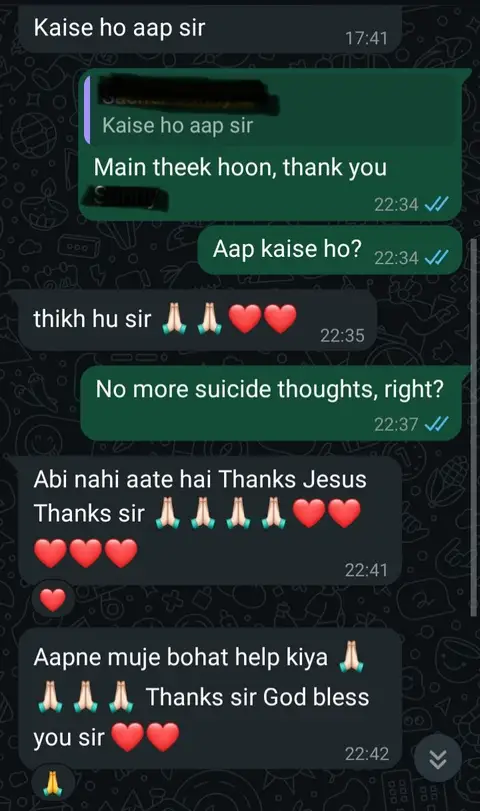
It’s been more than 4 months since, and I’m in touch with him regularly. There are other issues he needs help with: smoking, stress, weight, diet. But suicidal ideation is not one of them. I hope to meet him when I am in his town soon.
July 2025 update: one year on, he is still free of suicidal ideation and thoughts.
PS: My advisor, a busy healthcare executive, took the time to witness what unfolded from start to end, is so happy I did not listen, and is now a more vocal advocate of our work.
What we offer does not constitute medical, legal or financial advice. It is private intel. If you know anyone likely to end up in a hospital or an ICU, we are good people to talk to.